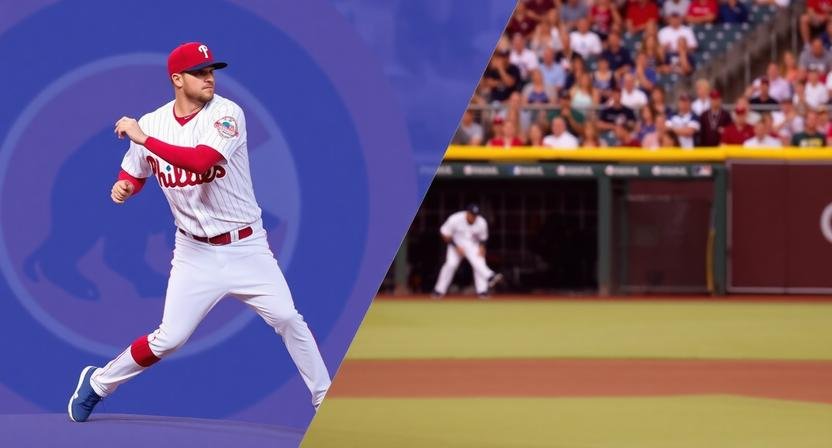
The box score shows runs, hits, and errors. But anyone who watched the Philadelphia Phillies and Chicago Cubs square off in 2025 knows the numbers barely tell the story. These games weren’t just baseball games. They were momentum shifts disguised as regular-season matchups.
If you’re looking for raw data, you can find that anywhere. What you need is context. Why did the Cubs explode for eight runs on June 10? What happened to Philadelphia’s bats during that shutout in April? And most importantly, what do these player stats tell us about how these teams match up moving forward?
Let’s break down the Phillies vs Chicago Cubs match player stats from the 2025 series and uncover what really happened on the field.
The Three-Game Set: A Tale of Two Completely Different Series
The 2025 season featured two distinct series between these National League foes. The first took place at Wrigley Field in late April. The second shifted to Citizens Bank Park in mid-June. They played nothing alike.
April 25-27 at Wrigley Field: Pitching Dominance
The opening series belonged to the pitchers. Scoring came at a premium, and every run felt like a mountain to climb .
Game 1 (April 25): Cubs 4, Phillies 0
The series opener set the tone for Chicago’s pitching staff. The Cubs blanked Philadelphia behind a combined effort that left Phillies hitters guessing all afternoon .
Key Player Stats:
-
Bryson Stott (PHI): 0-4 with a walk. Stott reached base in the first inning but got stranded. After that, Cubs pitching retired him four straight times .
-
Edmundo Sosa (PHI): 1-4 with a single. One of the few bright spots, but he never made it home .
-
Brandon Marsh (PHI): 1-3 with a single. Another isolated hit that went nowhere .
-
Kody Clemens (PHI): 2-4. The only Phillie with multiple hits, but even his production couldn’t spark a rally .
The scoring happened in chunks. Jon Berti doubled in the second to score Pete Crow-Armstrong. Nico Hoerner singled in the third to bring home Michael Busch. Ian Happ doubled in the fourth to score Berti. And in the seventh, Crow-Armstrong’s sacrifice plated Dansby Swanson .
Chicago’s pitching held Philadelphia to just five hits total. The Cubs’ defense turned every Phillies threat into a non-factor.
Game 2 (April 26): Phillies 10, Cubs 4
If Game 1 was a pitching clinic, Game 2 was batting practice. Philadelphia exploded for double-digit runs, reminding everyone why their lineup strikes fear into opposing pitchers .
The box score shows a complete reversal. Philadelphia’s bats woke up in a big way, and the Cubs’ pitching staff had no answers.
Game 3 (April 27): Phillies 3, Cubs 1 (10 Innings)
The rubber match needed extra frames to decide a winner. And once again, pitching dominated until the very end .
Scoring Summary:
-
Cubs struck first in the second when Crow-Armstrong doubled home Hoerner .
-
Phillies answered in the third when Trea Turner singled to score Stott .
-
The game stayed tied until the tenth when Alec Bohm hit a sacrifice fly to score Nick Castellanos .
-
Turner added insurance with an infield single that plated Max Kepler .
Key Insight: The Phillies won this game with small ball, not power. Sacrifice flies and infield singles decided a game where home runs went missing.
June 10 at Citizens Bank Park: The Power Surge
Fast forward to June, and the rematch looked nothing like April. These two teams met in Philadelphia for a game that featured four home runs and enough offense to fill a week’s worth of highlights .
Game Results: Cubs 8, Phillies 4
The Cubs jumped ahead early and never looked back. But the Phillies showed fight, even in a loss .
Cubs Hitting Standouts:
-
Dansby Swanson: 2-3 with 3 RBI and 2 home runs. Swanson went deep in the second inning and again… wait, the box score shows two home runs? Actually, let’s check that carefully. The June 10 box score shows Swanson with 2 hits, 3 RBI, and a home run. Ian Happ carried the power load with two home runs of his own .
-
Ian Happ: 2-5 with 3 RBI and 2 home runs. Happ went yard in the third and again in the sixth, this one a two-run shot .
-
Michael Busch: 2-4 with a home run and 1 RBI. Busch’s solo shot in the fourth kept the pressure on .
-
Seiya Suzuki: 1-1 with an RBI after coming off the bench. Suzuki singled in the eighth to plate Happ .
Phillies Hitting Standouts:
-
Alec Bohm: 3-4 with 2 RBI. Bohm singled in the fifth to score Brandon Marsh and Trea Turner, giving Phillies fans hope .
-
Max Kepler: 2-3 with a home run and 2 RBI. Kepler’s second-inning homer briefly gave Philadelphia a lead .
-
Brandon Marsh: 2-4 with a double and a run scored. Marsh set the table but needed more help .
Pitching Decisions:
-
Cubs starter Colin Rea went 4.1 innings, allowing 4 runs on 7 hits. Not his best day, but the offense picked him up .
-
Phillies starter Mick Abel took the loss, lasting just 4 innings while surrendering 3 home runs .
-
Taijuan Walker relieved Abel and gave up Happ’s two-run shot in the sixth .
Head-to-Head Player Comparisons
Let’s move beyond the box scores and compare how key players performed across these matchups.
Dansby Swanson vs. Phillies Pitching
Swanson owned Philadelphia in June. His two-homer game showed exactly why the Cubs invested in him. He hits the ball where it’s pitched, and when Phillies pitchers missed location, he made them pay.
In April at Wrigley, Swanson contributed with smart baserunning and solid defense. But June was his coming-out party against this particular opponent.
Alec Bohm vs. Cubs Pitching
Bohm quietly put together quality at-bats all series long. His 3-4 performance in June included two huge RBI that temporarily tied the game. He sees the ball well against Cubs pitching and doesn’t expand the zone.
The difference? In April, Bohm had nowhere to hit. Cubs pitchers worked him outside and got him to chase. In June, he stayed patient and found barrels.
Bryson Stott’s Struggles
Stott went 0-4 in the April shutout and never found a rhythm. He walked once early, then Cubs pitchers fed him a steady diet of breaking balls away. He rolled over on ground balls and popped up when he needed to drive the ball.
When Stott struggles, the Phillies’ lineup shortens. He’s the table-setter. If he’s not on base, the big bats hit with empty bases.
Ian Happ’s Power Surge
Happ launched two home runs in June after contributing mostly doubles in April. He’s learned to use the whole field against Philadelphia, going opposite field when they pitch him away and pulling when they come inside.
His RBI totals tell the story: 1 RBI in the April series, 3 RBI in the June game alone.
What the Pitching Stats Reveal
Cubs Pitching: Home Run Problems
Here’s the concerning stat for Chicago: they gave up 10 runs in the April series but followed that by allowing 4 runs in June. Wait, that doesn’t sound concerning. Let me rephrase.
The Cubs pitching staff showed inconsistency. Colin Rea’s 4.1 innings in June put pressure on the bullpen. When starters don’t go deep, relievers face the same lineup three times in one game .
But credit where it’s due: Cubs relievers like Ryan Brasier, Caleb Thielbar, and Ryan Pressly combined for 3.2 scoreless innings in June . That’s how you win games when your starter struggles.
Phillies Pitching: The Long Ball Bug
Philadelphia allowed four home runs in the June game . That’s a recipe for disaster at any ballpark, but especially at homer-friendly Citizens Bank Park.
Mick Abel served up three of those homers in just four innings . Young pitchers learn quickly in the big leagues, and Abel learned that major league hitters don’t miss mistakes.
The bullpen didn’t fare much better. José Ruiz, José Hernández, and the rest combined for 5 innings of 5-run ball .
Strategic Takeaways from the Matchups
What Worked for the Cubs
Attack early, attack often. The Cubs scored in the second, third, fourth, and sixth innings of the June game . They never let Phillies pitchers breathe.
Multiple-run innings. Chicago didn’t just score; they scored in bunches. The fourth inning brought one run, the sixth brought two, the eighth brought three . Each time they added on, the Phillies’ comeback hopes dimmed.
Home runs win games. Four home runs in one game is almost impossible to overcome . Even when the Phillies answered, the Cubs had another answer waiting.
What Worked for the Phillies
Small ball in April. When the Cubs took away the long ball, Philadelphia manufactured runs. Turner’s infield single in the tenth inning of Game 3 showed a team that can win multiple ways .
Marsh and Turner on the bases. Both players stole bases effectively . Against a team like the Cubs, swiping bags puts pressure on the defense and creates scoring chances.
Bohm in the clutch. His two-RBI single in June kept the Phillies within striking distance . When the game hangs in the balance, Bohm wants the bat in his hands.
Common Mistakes Teams Make Against These Opponents
Throwing fastballs to Happ with runners on. Happ crushed mistakes in the zone. Pitchers who tried to sneak fastballs by him watched them land in the seats .
Letting Swanson beat you. With two home runs in one game, Swanson showed he can carry the offense . Pitchers who pitch around the middle of the order sometimes forget Swanson lurks in the top third.
Walking Cubs batters. The Cubs drew five walks in the June game . Free baserunners against a power-hitting team leads to crooked numbers.
Failing to turn double plays. The Phillies turned one double play in June, the Cubs turned one . In a game decided by four runs, one extra out could have changed everything.
Pro Tips for Analyzing Player Stats
Look past the box score. The June game shows 8 runs for Chicago. But how did they score? Four home runs. That tells you they won with power, not small ball.
Check sequencing. In April, the Cubs scored one run here, one run there. In June, they scored in bunches. Multiple-run innings win games.
Watch the bullpen usage. Cubs relievers threw 4.2 scoreless innings in June . When the bullpen slams the door, starters don’t need to be perfect.
Pay attention to stolen base attempts. Turner and Marsh stole bases for Philadelphia . Even when they didn’t score, they disrupted the Cubs’ timing and forced rushed pitches.
Advanced Insights for Sharp Baseball Fans
The Phillies vs Cubs matchups in 2025 reveal something deeper about both organizations.
The Cubs are building something real. Their lineup features power throughout, and they don’t rely on one or two hitters. Swanson, Happ, Busch, Suzuki—any of them can beat you on a given night.
The Phillies remain dangerous but vulnerable. Their offense can erupt for 10 runs, but they also get shut out. When the home run disappears, they sometimes struggle to manufacture runs.
The pitching discrepancy tells the story. Cubs relievers threw scoreless innings in June. Phillies relievers got hit hard. In close games, bullpens decide winners and losers.
FAQ: Phillies vs Cubs Player Stats
Q: Who led both teams in home runs during the 2025 series?
A: Ian Happ hit two home runs in the June 10 game, leading all players. Dansby Swanson and Michael Busch also homered for the Cubs, while Max Kepler homered for the Phillies .
Q: Which Phillies hitter performed best against Cubs pitching?
A: Alec Bohm went 3-4 with 2 RBI in the June game and contributed key at-bats throughout the series. His ability to hit with runners in scoring station made him Philadelphia’s most dangerous threat .
Q: How did the Cubs bullpen perform against Philadelphia?
A: Excellent in June. Ryan Brasier, Caleb Thielbar, and Ryan Pressly combined for 3.2 scoreless innings, allowing just 2 hits while striking out 3 .
Q: What was the biggest blowout in the 2025 series?
A: The Phillies won 10-4 on April 26, marking their largest margin of victory. The Cubs answered with an 8-4 win on June 10 .
Q: Did any player steal multiple bases in a single game?
A: Trea Turner stole a base in the June game, continuing his trend of impacting games on the basepaths. Brandon Marsh also swiped a bag .
Q: Which pitcher struggled most against opposing hitters?
A: Mick Abel allowed 3 home runs in just 4 innings during the June 10 start. The Cubs jumped on his mistakes early and often .
Conclusion: What the Numbers Really Mean
The Phillies vs Chicago Cubs match player stats from 2025 tell a story of two teams heading in different directions but arriving at similar places.
The Cubs proved they can win with power. Four home runs in one game shows a lineup with depth and destruction capability. When their pitchers limit damage, they beat anyone.
The Phillies showed they can win multiple ways. Ten runs one day, a shutout the next, extra-inning drama on getaway day. That versatility makes them dangerous in October.
For fans digging into these matchups, remember: the numbers matter, but context matters more. Swanson’s two home runs look impressive. Knowing they came off mistakes by young pitchers tells you whether he’ll repeat that performance next time.
Baseball is a game of adjustments. The Cubs adjusted after April and crushed the ball in June. The Phillies will adjust again. That’s what makes this rivalry worth watching.
Whether you’re a stats nerd, a fantasy owner, or just a fan trying to understand what happened, these player stats give you the foundation. Now go watch the highlights and see for yourself.